

Understanding Credit Enhancement in Trade Finance
Trade finance has always been about trust and that trust is no longer based on relationships alone it is built on verifiable financial backing. Whether a deal involves commodities, infrastructure, or cross-border supply agreements, counterparties want certainty. They want to know that performance will be delivered and payments will be made.
This is where credit enhancement comes into play. Bank Guarantees (BG) and Standby Letters of Credit (SBLC) have become essential tools for reducing risk, unlocking liquidity, and ensuring transactions move forward without hesitation. While both instruments are widely used, their real value lies in how they are structured and applied in practice.
Understanding that difference is what separates stalled negotiations from successful deal execution.
The Role of Credit Enhancement in Trade Finance
At its core, credit enhancement strengthens the financial position of a party in a transaction. It provides reassurance to lenders, sellers, and investors that obligations will be met, even if challenges arise.
In trade finance, risk comes from multiple directions. A supplier may worry about non-payment. A buyer may question whether goods will be delivered as agreed. Lenders may hesitate to fund a deal without adequate security. These concerns can delay or completely block transactions.
Credit enhancement tools solve this by introducing a credible financial institution into the equation. When a bank stands behind a transaction, the perceived risk drops significantly. This shift often makes the difference between a rejected proposal and an approved one.
Among the most effective instruments used for this purpose are BG and SBLC.
Understanding Bank Guarantees (BG) in Practice
A Bank Guarantee is a commitment issued by a bank on behalf of its client. It assures the beneficiary that if the client fails to meet contractual obligations, the bank will compensate for the loss.
BG – Bank Guarantee are closely tied to performance. They are commonly used in situations where one party must prove its ability to deliver on agreed terms.
For example, in a construction contract, a developer may be required to provide a performance guarantee before work begins. This gives the project owner confidence that timelines, quality standards, and contractual milestones will be met. If the developer fails to deliver, the guarantee can be called.
This structure creates accountability. It aligns incentives and reduces the operational risk associated with complex projects.
BG – Bank Guarantee are widely used in:
1 Infrastructure and construction projects
2 Government tenders and public contracts
3 Equipment supply and procurement agreements
What makes Bank Guarantee effective is their direct link to contractual obligations. They are precise, clearly defined, and tied to specific outcomes. However, this also makes them less flexible compared to other financial instruments.
How SBLC Function in Trade Finance
A Standby Letter of Credit serves a different purpose. While it also provides a form of guarantee, its primary role is to secure payment rather than performance.
An SBLC is issued by a bank to ensure that a beneficiary will receive payment if the applicant fails to meet financial obligations. In simple terms, it acts as a backup payment mechanism.
This makes SBLCs particularly useful in cross-border trade, where counterparties may not have established relationships or where legal enforcement can be complex. By introducing a bank-backed payment assurance, both parties gain confidence to proceed.
Beyond basic payment security, SBLC provider are often used in more advanced financial structures. They can enhance a company’s credit profile, support borrowing capacity, and even be leveraged in structured funding arrangements.
Typical uses of SBLC include:
1 Securing international trade transactions
2 Supporting financing and credit lines
3 Enhancing balance sheet strength for large deals
Unlike BG, SBLC are not always tied to a single contract. Their flexibility allows them to be integrated into broader financial strategies, making them a preferred tool in sophisticated trade finance structures.
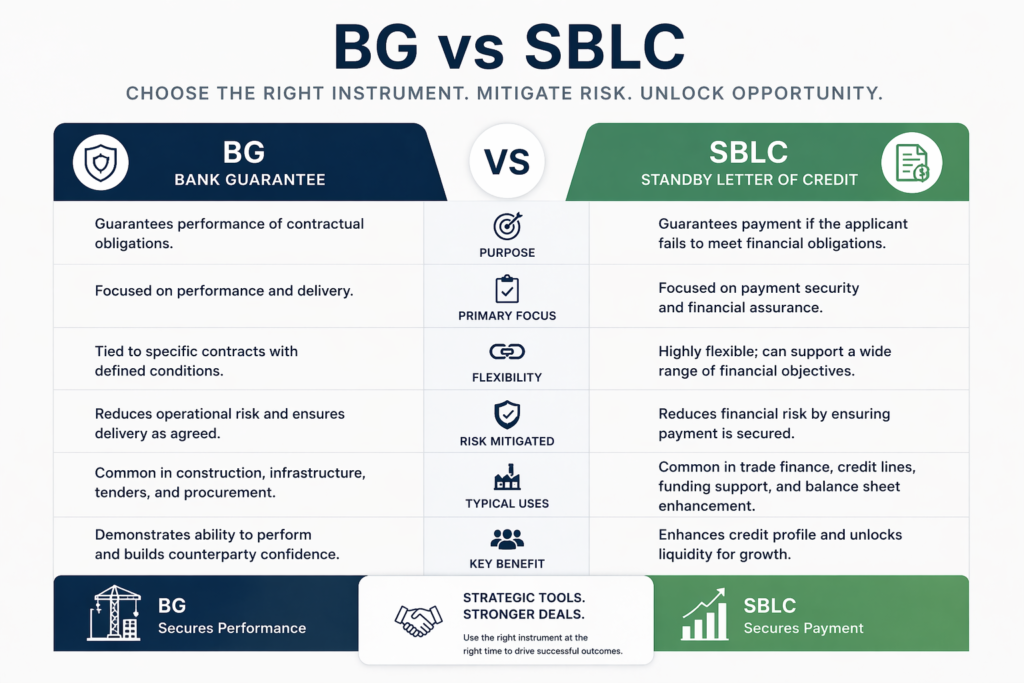
Key Differences That Influence Decision-Making
Although BG and SBLC are sometimes grouped together, their practical applications differ in important ways.
A BG focuses on performance. It ensures that contractual obligations are fulfilled and provides compensation if they are not. This makes it ideal for execution-heavy projects where delivery is the main concern.
An SBLC focuses on payment. It guarantees that funds will be available even if one party defaults. This is especially valuable in transactions involving large sums or international counterparties.
Another difference lies in flexibility. BG are usually tied to specific contracts with clearly defined conditions. SBLC, on the other hand, can be structured in a way that supports a range of financial objectives, from trade finance to credit enhancement.
Risk perception also varies. A BG reduces operational risk by ensuring performance. An SBLC reduces financial risk by securing payment.
These distinctions matter because choosing the wrong instrument can create unnecessary friction in a deal.
Applying the Right Instrument at the Right Time
The effectiveness of BG and SBLC depends largely on timing. Each instrument serves a purpose at a different stage of the transaction lifecycle.
During the bidding or negotiation phase, a Bank Guarantee is often required to demonstrate credibility. It shows that a company has the backing needed to take on the project and deliver results. Without it, many contracts especially government tenders are simply not accessible.
Once a deal moves into the financing stage, the focus shifts. Lenders and investors want assurance that their capital is protected. This is where SBLC become more relevant. They strengthen the financial structure of the transaction and make it easier to secure funding.
In many cases, both instruments are used together. A BG may secure the contract, while an SBLC supports the financial framework that brings the project to life.
This combined approach is common in large-scale deals where multiple layers of risk need to be managed simultaneously.
Unlocking Liquidity Through Structured Solutions
One of the most significant advantages of credit enhancement is its ability to unlock liquidity. Many companies have strong opportunities but lack the immediate financial capacity to execute them.
Cash-backed instruments address this gap. By providing a guarantee or credit enhancement backed by real funds, they create access to financing that would otherwise be out of reach.
For example, an SBLC can be used to support a borrowing facility. With the bank’s backing in place, lenders are more willing to extend credit. This allows companies to move forward with transactions that require substantial upfront capital.
Similarly, a BG can enable participation in contracts that demand financial assurances. Without it, even qualified companies may be excluded from high-value opportunities.
The key is not just having access to these instruments, but understanding how to structure them effectively.
The Importance of Credibility in Modern Trade
The expectations in trade finance have changed. Counterparties are more cautious, due diligence is more detailed, and financial transparency is no longer optional.
A well-structured BG or SBLC signals that a transaction is serious, secure, and ready to proceed. It also simplifies negotiations. When financial assurances are clearly in place, discussions can focus on execution rather than risk concerns. This often leads to faster deal closures and stronger partnerships.
How Elro Vision Ltd Structures These Solutions
The effectiveness of Bank Guarantee and SBLC solutions depends heavily on how they are arranged. This is where experience and access to the right financial networks make a difference.
Elro Vision Ltd works with clients to structure cash-backed BG and SBLC solutions tailored to real transaction needs. Rather than offering generic instruments, the focus is on aligning each solution with the specific requirements of the deal.
For importers, exporters, traders, and project developers, this means having access to financial tools that are both credible and practical. Whether the objective is to secure a contract, enhance credit, or support a funding strategy, the structure is designed to facilitate execution.
The emphasis is on reliability. In trade finance, a financial instrument is only as valuable as the confidence it creates. By ensuring that BGs and SBLCs are properly backed and correctly issued, transactions can move forward without unnecessary obstacles.
Turning Financial Instruments Into Results
There is a clear difference between understanding BG and SBLC in theory and using them effectively in real transactions.
In practice, success comes from knowing how to position these instruments within a deal. It involves timing, structure, and alignment with the expectations of all parties involved.
A well-placed BG can open the door to new contracts. A properly structured SBLC can secure the funding needed to execute them. Together, they form a foundation that supports growth and expansion.
As trade becomes more global and competitive, this level of financial structuring is no longer optional. It is part of how serious business is conducted.
Credit enhancement has become a central component of modern trade finance. Bank Guarantees and Standby Letters of Credit are not interchangeable tools they serve distinct purposes and address different types of risk.
When used correctly, they reduce uncertainty, improve credibility, and create pathways for transactions that might otherwise never happen.
For businesses looking to operate at a higher level, understanding these instruments is essential. More importantly, working with the right structure and support can turn them into powerful enablers of growth.
Explore our Financial Solutions to support your next transaction: Bank Guarantee Provider